
Unit 332 - Managing a Social Media Campaign
1.1 - Campaign Research

The #ExploreBCLater (British Columbia) social media campaign was made during the Covid-19 pandemic as millions of people had to cancel their holiday plans. The platforms this hashtag is being used on are Instagram, Twitter and Facebook and it has been fairly successful because there are around 15,000 posts on each platform with the hashtag. The purpose of this campaign was to encourage people to stay at home as it is a spin on the already existing campaign #ExploreBC which encouraged people to get out and explore. Although this campaign encouraged people to stay at home, it also encouraged travellers to post their existing experiences so that the people who are stuck at home can still see the beauty of the world from the comfort and safety of their homes. The target audience for this campaign are people who are affected by Covid and want to get out (so Explorers, according to the psychographics). Some legal issues with this campaign are that some people went out, when in lockdown, and took pictures/recorded new content which is nice and all, but the idea of the campaign was to ExploreBCLater and encourage people to stay home. Another legal issue, which is similar to the first one, is that this campaign relies on UGC (user generated content) so people might want to contribute and show what their experiences are. There aren't any ethical issues with this campaign apart from the content not being filmed at British Columbia but i don't think people would really notice or care if it isn't. The reason this campaign was successful was because of the pandemic, as without it, people would be able to just travel where they wanted and see what they wanted. Currently, the hashtag has had around 15,000 posts on each of the social media platforms used and the numbers are still rising.



The original idea for Dumb Ways to Die was to create a song about safety when near train tracks, the people behind this campaign were the Marketing team at Metro Trains in Melbourne. The Music video, within 6 months, had already hit 50+ million views on YouTube, over 3.2 million shares of Facebook, over 100,000 retweets on Twitter and became the third most popular ad of all time. The over all purpose of this campaign was to tell people not to be dumb around trains and it quickly achieved this goal with over 44,000 Melbournians pledging "not to do dumb things around trains" within four months of the campaign launching. A mobile game was also made, following the success, which was also very successful, with around 3 billion unique plays, so they made a sequel as well. The initial target audience for the Dumb Ways to Die campaign were people in Melbourne however due to it going viral, this quickly applied to everyone. There aren't really any legal issues with this campaign as it is very clear in the message that they are putting across, however some ethical issues could be that some people get offended at the way they have portrayed the characters and that if you have no teeth them you are seen as dumb. The impacts of this campaign were huge, as they reduced near misses and general accidents by 10% is just a year, so over all this campaign was very successful.


OfficeMax launched a website in 2006 called Elf Yourself, where you can upload pictures of you or your friends and family to make them dance as Elves. This fun new video generation was spread all over Facebook as it was the leading social media at the time, it was also sent through email and Facebook now have an AR filter that has been added to loads of other social media sites like Instagram, Snapchat, Twitter and YouTube. The purpose of Elf Yourself was humour and it was a funny filter to kickstart all the different ideas for filters. The message behind Elf Yourself, as much as there isn't really one, is just turn yourself, friends and family into elves and watch them dance in different ways and that is what the content is for this campaign. The target audience for this campaign would be men and women from the ages of 15-30 as it would be funny and amusing to this age group and from personal experiences of Elf Yourself, it is. When making this service, OfficeMax would have to think about the legal and ethical issues with Elf Yourself, for example some legal issues would be any copyrighted dances used and copyrighted music, and some ethical issues would be because you can upload your own photos, some people might take it out of hand with the pictures they use or if this service was used by people that don't celebrate Christmas they might not find it amusing. The success of Elf Yourself was amazing, as they managed to get around 200 hits per second and 8 elves generated per second, surprisingly Elf Yourself still comes around every year and shows no signs of stopping.
1.2 Develop a Social Media Campaign
1.2 Develop a social media campaign aimed at promoting a specified product, service or event to an identified audience
-
Client Focus Group Meeting Minutes
This is a PDF document on my WIX site, however for this part of the project we had a talk with our clients about the idea they had and everything was noted down on a separate document.
-
Content Idea Mindmap
-
Campaign Outline
Our campaign outline is that we will make a 25-30 minute long documentary showcasing the work done by Robins Education over ten years to get it to where it is today. We will be showing off the education programme and how you will be working in the stadium and how it is very different from normal colleges.
-
Purpose & Rationale
The purpose of this documentary is to spread awareness of the Robins Foundation and Robins Education and to show the journey that the students and coaches have been on throughout the years. The reason for us choosing this approach is because we want to make an inspirational style documentary to show the journeys of all the people involved with Robins Education.
-
Aim & Objectives (SMART)
-
Identified Stakeholders & Influencers
Our stakeholders and influencers for this documentary would be Chris Stenner, Jon Lansdown, Teachers, EFL Trust, etc. The reason we would like to have these stakeholders is because they have all had a huge impact on the Robins Foundation and Robins Education. For example, we want Chris Stenner to be the face of the documentary as he has been with the foundation since the start and has the most experiences with the Foundation.
-
Tools & Platforms
The platforms we would use for this documentary would be the Bristol City Website, The Robins Foundation YouTube channel, Twitter, Instagram, Facebook and even TikTok for funny bits. We would be posting the full documentary on The Bristol City Website, YouTube and Facebook as it allows it to be posted as Instagram and Twitter allow short form videos, so we would be posting trailers to these platforms.
-
Campaign Timeline
-
Campaign Budget
For our Campaign Budget, Per pound you spend on instagram marketing it will gage a 260-680 person reach. If we had a £200 budget for marketing and spent it all on instagram, £20 a day for 10 days - would create a reach of 35,000-93,000.
-
Target Audience
For our target audience, it would be different for each platform as the video posted on Facebook would be viewed more by parents than the Child, and the video posted on Instagram would be viewed by the Child more than the parents. The age range we would be targeting this documentary towards would be ages 15-18.
-
Sample Materials
For this documentary, we made a rough example of the style of interview we would be going for, which is a walking interview around the pitch and the reason we have chosen this style is because we would like to show off the fact that the course is at Ashton Gate. We also took some general B roll shots of the play on the pitch day as it shows the community reach.
-
Contingencies
If anything was to go wrong with the documentary, our contingency plan would be to make an extended list of all interviewees that would be willing to be a part of the documentary just in case our first choice of interviewees are unavailable.
-
Pitch Video
-
Pitch Slides
This is a PDF document here.
-
Pitch Feedback
The Pitch feedback is at the end of the Pitch video, once everyone has pitched their ideas.
We were pitching in front of Chris Stenner, so we could get some feedback from the head of the Robins Foundation. After this pitch, there were a couple things that needed to be changed. For example, on the media day, we can now use the players changing room as an interviewing room for the staff members and we will use the new BCFC kits as a back drop. Another thing that needed to be changed is the b-roll were planning to use, as they would like to show various parts across the 10 years and we only had footage of the past couple of years, so Chris will be sending us some archive footage.


Finished Content


Dec Stone Case Study
Jimmy Woolen Case Study
1.3 Analysing Success


Here are the YouTube analytics for the 10th Anniversary Robins Foundation Documentary. The video in whole was around 27 minutes long and had an average view time of 4 minutes, which is 2 minutes longer than usual. In total the documentary has around 1.7k impressions, which is the amount of people who saw the video but didn't necessarily watch or click on it. The video has a 3% click-through rate and 140 views, which is 60 more than usual. This documentary saw 118 unique viewers coming to the Bristol City channel and an average watch time of 9.4 hours which is 7.4 more than usual. So overall, you can see that the documentary did quite well on YouTube as you can see from the analytics having a gradual incline.


Here are the Twitter analytics and the posts that went out over the Robins Twitter accounts and Toby Osborne's account. Looking at the impressions to engagements, I can see that a lot of people saw the posts but not many actually clicked on it or viewed it. For example, looking at the analytic above, it received 4.2k impressions and 829 views which is probably the best out of these. The engagements on this however are only around 163, which shows that it didn't attract as much attention as we hoped but it still did well. One analytic that stands out is the 'New Followers' bit as for all posts, not one new follower was made. This could be because the people who viewed the posts are already following the accounts or that people just don't go around following accounts from the posts they see. For each post there were some profile views so this is a slight anomaly.


Here are the LinkedIn analytics from 10 year documentary and case studies. For all videos, there is a consistency of views that range from 80-260. This is less than the other platforms that I've seen as LinkedIn is used more for business/jobs than what Instagram and Twitter are used for. Most of these viewers would probably be people linked wit the club and older/business owners and workers. The impressions on LinkedI are also lower as on other platforms, the impressions were in the thousands but these are highest at 648. When It comes to where to post your media, in this case the documentary and case studies, Instagram and Twitter are better platforms as they reach the younger audience that you would want to be engaged in the club but on LinkedIn, there is a more specific target audience with less of a age band. Something interesting is the shares that the posts got, some didn't get any but others got shared once, twice or 3 times, Twitter received some retweets but LinkedIn has seen the most shares on any platform at the moment.


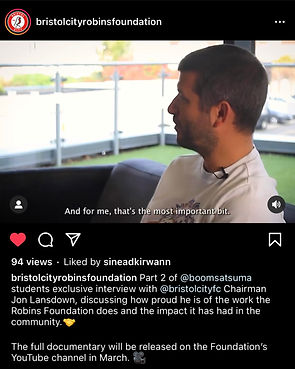
Here are the Instagram analytics from the Robins Foundation account and boomsatsuma account. Overall, looking at all the screenshots, the impressions are around the 1000 mark and the accounts reach are also around that mark. just looking at the bottom right screenshot, you can see the impressions and where they came from. There's 1189 total with 547 coming from the home page, 439 from other and 203 from the profile it was posted on. Based off of these analytics, I can see that this was either a case study or a promotional graphic/video. I can tell this from the interactions as there was only 56 likes and the main documentary received around 100. Again, there were some profile visits and no follows, this was probably due to them already following them or not finding the content engaging enough to want to keep updated.




Here are the Analytics for Facebook which show the same information as the other platforms but it is worded differently. The impressions are the people reached, which is around 400-1200 other the posts. This is very similar to Twitter, Instagram and YouTube but LinkedIn is less since it is used by a specific audience. With Facebook, it shows more analytics on the watch time/clicks as Facebook has revenue through clicks and watch time, like YouTube.