
Creating Composited Video
1.1 Video Essay
For this video essay, I explained how I made edits for Chromakey, Cloning, Frame Blocking, Double Exposure and Picture-in-picture. For each edit, I explained the steps I took to get my final outcome, for example I said how I used the ultra key effect to erase the green screen and the crop tool to crop out the creases in the green screen.
1.2 Production


This is a mindmap of our initial ideas for the Robins Foundation Documentary and a mindmap showing the types of shots we would like to take.
Rationale
The purpose of this documentary is to spread awareness of the Robins Foundation and Robins Education and to show the journey that the students and coaches have been on throughout the years. The reason for us choosing this approach is because we want to make an inspirational style documentary to show the journeys of all the people involved with Robins Education.
Target Audience
For our target audience, it would be different for each platform as the video posted on Facebook would be viewed more by parents than the Child, and the video posted on Instagram would be viewed by the Child more than the parents. The age range we would be targeting this documentary towards would be ages 15-18 as the content will appeal to them and excite them to join the Robins Foundation for their education moving forward. As said in the documentary, the Robins Foundation is a great place for people who are still unsure on what they would like to pursue as they use the atmosphere of football to make them enjoy learning. Parts of the documentary that will excite and attract the target audience will be the b-roll of students playing football at South Bristol Sports Centre and other centres around the country.
Legal and Ethical Issues
Some legal issues we could have with this documentary would be GDPR (data protection), which can be avoided by getting permission from interviewees to have them in the documentary and having members of the public who have concerns to sign a model release form. Another legal issue we could have is not having permission to film in certain areas, which is unlikely to happen as we are in the same buildings the foundation but anything can happen.
Some ethical issues we could have is not wording something right and the foundation could take offence to this and prevent us from publishing the documentary, which again is very unlikely to happen. Same goes for visuals, if we shine light on something and then don't address it further, this won't look good for the foundation as they've built their reputation on being open, helpful and professional. This won't show that, however again this is unlikely to happen.
Location Recce's & Production Info


I will be attending the game on Wednesday 27th at 10:30am at South Bristol Sports Centre. If this date isn't confirmed by Tuesday and is changed, I will go to the game at 1pm.
Story Board of editing in scene
These are the Story Boards, showing the types of edits we will be doing for the Robins 10 year documentary.
Raw Footage
This is a raw footage montage showing a variety of different filming we had to do to make this documentary happen. For example, there is the Toby Chris interview, there's some Robins Foundation training footage, there's some class room footage, etc.
Storyboard Comparison

This is the Jon Lansdown interview that was storyboarded and is now filmed. We used a two camera set up to film this, with one camera facing him with a shot of the stadium in the back and the other camera shows a side profile.
Premiere Pro Annotations
This is where all the raw unedited footage is held for when I need it

This is the editing timeline which shows the order and placement of all the footage
In this screenshot, I am on the effects tab which allows me to add different effects to the timeline to help transition the clips.
This is the video effects tab, which is used to transition between each clip and is also used for other techniques like chromakey and wipes

This is the premiere timeline for the Double Exposure composited scene. The start of the intro shows some photos from the past 10 years, then as the music picks up the pictures start flashing faster and the 10 comes into shot. The way this is done is by key frames, the "10" would've started all the way zoomed in, then as the music picks up it will zoom out until it fits the frame. Finally it fades to gold as the last pictures are shown.
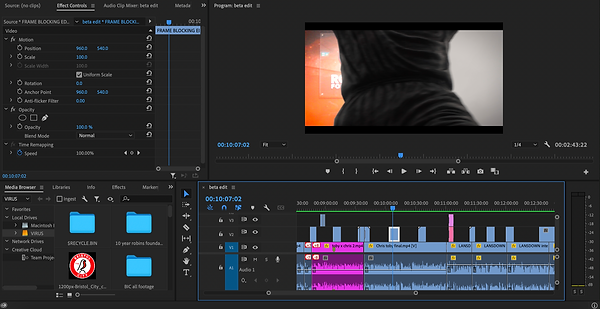
This is the premiere timeline for the frame block transition composited scene.
To make a frame block transition like this one, you will have to mask frame by frame each bit of the original clip so that when the camera goes from right to left, the left side of the statue is completely masked over and the other clip can be placed on top of the masked clip, which creates this seamless transition.

This is the picture-in-picture composited scene on the premiere timeline. To make this edit, all you have to do is sync up the two clips you would like to make picture-in-picture, place the reaction clip on the clip they are reacting to and scale down the reacting clip so that it fits in the corner of the frame, like a reaction channel video.
Composited shots using Story Boards

This is the Double Exposure composited scene which showcases many photos of the past ten years for the Robins Foundation. This is the intro to the documentary and is edited to the music, which was made on Garage Band, and snaps on beat between many different pictures of students and staff and many other contributors of the club.

This is the frame block transition composited scene for the documentary, although I didn't edit this exact scene, I have done this edit many times before and it requires a lot of patience.
To make a frame block transition like this one, you will have to mask frame by frame each bit of the original clip so that when the camera goes from right to left, the left side of the statue is completely masked over and the other clip can be placed on top of the masked clip, which creates this seamless transition.

This is the final composited scene in the documentary, which is picture-in-picture. To make this edit, all we needed to do is sync up the staff interviews with Chris' reaction and then put Chris' clip on the staff interview clip and scale down Chris to one of the corners so it looks like a proper reaction like on other YouTube videos.
Offline Edit
This is the offline edit for the 10 year Robins Foundation documentary. There are still many changes and stuff that need to be added, but this is everything that was needed by the deadline in the documentary.
Final Documentary
This is the final documentary, however the intro and outro need to be changed as the intro has too many recent photos and Chris would like to show a lot of variety for the 10 years. The outro hasn't been made yet as we are still waiting for the outro graphic and call to action.
The things I was able to change that Chris wanted was the order of Clare's interview as it made more sense by her introducing her daughter first. I also had to get some older b-roll footage as they want to show a variety over the 10 years.
1.3 Unit Evaluation
Unit 324 Project Evaluation
For the unit 324, I had to make a video essay for 1.1 which was me explaining how to make different composited edits in premiere pro. The edits I had to make were Chromakey (green screen), Cloning, Frame blocking, Double exposure and Picture in picture. What went well with this challenge was the fact that I didn't need to waste time on a Picture in Picture edit as I recorded my video essay in premiere so there was the recording of premiere and there was the video player in the top right. However, for cloning we weren't allowed to move the camera as it would mess up the shot so I was only able to get two of me in the same clip. Something I would do differently is spacing myself out more for the cloning shot as I wasn't able to cut in-between some of the Joe's.
For 1.2, we had to make a Robins Foundation 10 year documentary, which started on the media day that went really well for content as we were able to get all the staff and student interviews. Something that didn't go as smoothly was the b-roll shoots, these were great for content, however we needed more of a variety in the b-roll content we had as we were missing some girls football and older Robins Foundation content. To improve on this part of the unit, I could've recorded more quantity over quality as this would have given us a lot more b-roll footage to use.
In conclusion, I believe that for the time we had to finish this documentary, we did quite well as the finished offline edit works for what Chris wanted, but there were a few things he wanted to tweak so that it wasn't mainly focussed on him.
Looking back at the documentary, I wish we would have stuck to the b-roll shot list more as we got a bit carried away and there is a lot of unused footage that doesn't equate to the documentary or the Robins Foundation.

This is the shot list we made at the start of the project, however we strayed away from it as we were more focussed on the interviews we needed to film, like the student and staff interviews on the media day.